Showing posts with label Watchmen. Show all posts

Monday, November 3, 2008

Comic Book Fan Entitlement: Doing Justice to the Source Material

In my first blog post, I suggested that in today's superhero-obsessed Hollywood, the worlds of comic books and comic book films are becoming increasingly entwined. Naturally, comic book fans are among the prime demographic to which comic book films are targeted. This also means that such pulp fiction enthusiasts are the hardest to please when it comes to the adaptations of certain superheroes. Spending one minute perusing any message board or reading blogs dedicated to the discussion of comic adaptations is enough to recognize the variety of differing, and often very passionate, opinions on the matter. One begins to notice a sense of entitlement, the impression that these fans feel they deserve quality adaptations. A portion of a recent essay from Michael Peterson entitled "A Question of Accessibility: Studying Pathology and Archaeology" got me wondering, how does a comic book film do justice to the source material in ways that please the core audience? Peterson writes, "A film audience doesn't want a Batman story, they want the Batman story." In my exploration of the blogosphere this week, I decided to search external blogs concerning "important" properties that are dear to the hearts of comic book fans and critics alike and whose film adaptations are currently in the works: Superman (pictured to the left) and Watchmen (pictured below to the right). My goal was to discover what certain aficionados thought it might take to make the Superman story or the Watchmen story, and also to provide my own thoughts. The first post, "What To Do With The Superman Movies," is, as the title clearly states, a suggestion by blogger "dailypop" on how best to handle the next installment of the aforementioned franchise. The second, "A Bit More On The Watchmen Movie," is a critique of the Zack Snyder's upcoming adaptation written by "Ampersand" from Alas, A Blog. My comments can be read below, or in context by following the adjacent links.

"What To Do With The Superman Movies"
Comment:
First of all, thank you for an inspired post providing your own personal insight to what is going on in the world of superhero movies. For some reason, I have found that most blogs on the topic merely relay comic book film news without much critical analysis involved. By identifying Superman as the "blueprint for the superhuman hero," you acknowledge the fact that great care must be taken in adapting the iconic character the screen correctly. Indeed, "the idea of a man flying" is not enough to inspire awe given today's limitless usage of CGI. I actually thought that one of the strengths of Bryan Singer's Superman Returns was that it addressed the possible irrelevance of the character in contemporary society, illustrated in the film by Lois Lane's article, "Why The World Doesn't Need Superman." However, the underwhelming response to that film proves that a modern Man of Steel movie must go even further to eradicate any public notion that Superman is obsolete and connect with viewers on a higher level. Perhaps the themes of "madcap inventiveness and absurdity played against mundane everyday life" that you mention are a step in the right direction, though I feel it needs to go even further than merely the absurd, perhaps setting the ordinary against the divine. Superman is morally incorruptible and virtually indestructable, essentially a god. I think the next Superman film must remind us why he is the hero that all other superheroes look up to, go grander with its themes yet still retain a more personal human element to which viewers can relate. That said, I was curious as to your thoughts on Mark Millar's recent proposal for an epic Superman reboot, an eight-hour, Lord-of-the-Rings-like trilogy that would chronicle the entire life of the character, starting a thousand years ago on Krypton and ending "with Superman alone on Planet Earth, the last being left on the planet, as the yellow sun turns red and starts to supernova, and he loses his powers.” Do you believe your idea could work within the framework of Millar's concept or is his more in the darker vein that you feel inappropriate for the series?

"A Bit More On The Watchmen Movie"
Comment:
Thank you for your insightful analysis of the upcoming Watchmen adaptation with regard to its original source material. I agree with your point that the film's slavish reproduction of the graphic novel will not necessarily translate into a quality film. Much of the enthusiasm for the film spawns from its apparent frame-by-frame adherence, rather than the possibility for it to achieve for films what the original Watchmen did for comic books, that is to comment upon and deconstruct the medium from which it comes. You say "it's not going to be as good as the comic." While I agree that the adaptation will probably not be as groundbreaking to the medium of film as the comic was to its medium, I do believe that it has the potential to be innovative in the ever-expanding genre of superhero films. Several things I have seen and heard about the film seems to be deliberately reflecting on superhero films of the past. For instance, the changes made to both costumes of Nite Owl and Ozymandias for the film bring to mind the flambuoyant rubber costumes from Joel Schumacher's Batman films. Indeed, Ozymandias' suit actually sports those infamous nipples... Given the notoriety of Schumacher's series, one can only assume that Zack Snyder is intentionally exploiting this style in a symbolic way and not attempting to replicate it based on any sort of "cool" factor. A big reason I think Watchmen is employing intelligent pastiche instead of empty reflexivity is based on the music used in the trailer. The song is Smashing Pumpkin's "The Beginning is the End is the Beginning," written for the soundtrack to Schumacher's Batman & Robin. Snyder admitted at Comic Con 2008 to choosing the song ironically based on its "lineage." These touches give me hope that the movie "looks like every other superhero movie that’s come out in the last few years" on purpose. Perhaps one reason to admire the film is because it deviates from the aesthetic of the original graphic novel. Rather than subvert the visual style of existing superhero movies, as its comic predecessor did, maybe the film is subverting the source material itself by exploiting those formal techniques to achieve a different end. Either that, or Zack Snyder is simply trying to make a movie that looks cool, which may very well be the case judging by his slick previous effort 300. Still, I would rather give Watchmen the benefit of the doubt until I see it.

Monday, October 27, 2008

Superhero Sophistication: Transcending Funnybook Status

In one of my cinema classes last week, I had the privilege of seeing a mostly unknown independent film called Special (pictured to the right). It was a moving story about a man who comes to believe he possesses superpowers as the result of an experimental antidepressant. I left the theater impressed by this more mature, realistic take on the conceit of the costumed crimefighter. More notable, however, was the fact that a superhero film was, for once, a low-budget indie endeavor rather than a multi-million-dollar Hollywood blockbuster, and based on an original concept no less. Unfortunately, the movie has had hardly any exposure, save for a few festival runs, and will only be released in a few select theaters in November. While I do not expect Special to perform exceptionally well at the box office due to the limited nature of its distribution, its mere existence reaffirms a suspicion that I have gradually come to harbor based on current industry trends, that superhero films are becoming respectable.

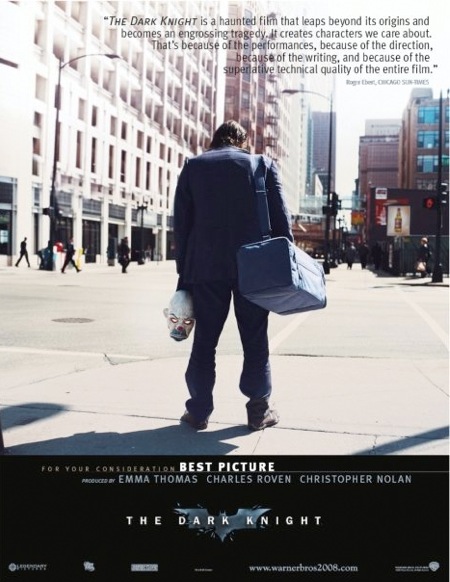
For evidence of this shift into reputability, look no further than to the critical and financial phenomenon that was this summer's The Dark Knight. The film generated Oscar buzz even before its release and will be re-released in theaters this January for the consideration of Academy voters. In addition, Warner Bros. has started campaigning for a supporting actor nomination for the late Heath Ledger's performance as the Joker (whose influence can be seen in the vandalized Oscar poster below), and there is talk of the film garnering support in even more categories. Can the latest Batman installment do for the superhero genre what Peter Jackson's Lord of the Rings trilogy did for the fantasy genre and elevate costumed crimefighters in cinema to a level of prestige? Only time will tell. For now, it might be worthwhile to examine exactly how and why director Christopher Nolan's interpretation of Batman has gained such high esteem. First, Nolan's masterful casting decisions have contributed greatly to the growing respectability of the superhero genre. His two Batman films are replete with award-winners and nominees like Michael Caine, Morgan Freeman, Liam Neeson, Tom Wilkinson, Ken Watanabe, and of course, the aforementioned Ledger. Indeed, filmmaker Jon Favreau credits Nolan's Batman Begins with first showing "that you could bring an independent film sensibility and cast to a big movie and transcend it a bit." Favreau recruited equally reputable actors into his own Iron Man series, which was also a critical and financial success this summer.

Aside from the note
worthy talent involved, The Dark Knight and Iron Man share another element in common that has catalyzed the rise in cultural status for superheroes: sociopolitical relevance in a post-9/11 America. The two films deal with the current political climate in different ways. For instance, the villain of The Dark Knight, essentially an anarchist with no morals or motives, brings to mind the enemy in America's war on terror. Batman ponders to what extent he is responsible for the violence he has set out to stop in the first place. As some believe the U.S. has done in Iraq, Batman's war on terror has only fueled the fire, spawning even more radical and dangerous villains than before. In Iron Man, the actual war in Afghanistan is worked into the character's origin story, while the protagonist also battles over his own destructive contributions as an arms manufacturer for the military. In short, superhero films have moved out of the realm of escapist fantasy and started to confront real world issues through metaphor. As a result, viewers are able to take the genre more seriously than before.

Can superhero films keep up this trend of respectability? Well, since Warner Bros. has decided to try and replicate the "brooding tone" of The Dark Knight in future movies based on DC Comics properties, perhaps the studio will also continue to infuse significant allegory. For example, the upcoming Watchmen film, with its political overtones and alternate Cold War history setting, leaves plenty of room for commentary. The Richard Nixon of the graphic novel, who has managed to remain in office well after two presidential terms, could easily provide an opportunity to draw parallels to the current administration. Furthermore, the fact that the United States enlists the brutal aid of superheroes in the Vietnam War might also offer possible analogies for the Iraq War. In addition, the cast of relative unknowns makes the film seem more like an independent movie than a mainstream blockbuster, even more so than the The Dark Knight or Iron Man. The original limited series on which Watchmen is based is already a reputed work on its own as the only graphic novel on Time's 2005 Top 100 List of All-Time English Language novels. It remains to be seen, however, whether or not this high quality will translate in the adaptation from comic to film.

While The Dark Knight, Iron Man, and Watchmen share common political themes, I do not think their merit relies solely on the fact that they deal with current political issues. That is to say that reputability and political relevance are not mutually exclusive. Whether addressing grand issues of national security or the personal problems of a single man, as in the aforementioned film Special, costumed heroes have begun to enter a new stage of prominence in both Hollywood and independent cinema. It is my hope that the current surge in popularity of superhero cinema will inspire less adaptations and more original concepts as in past movies like Unbreakable, Hancock, and Special. One thing is certain, that the sheer volume of comic book adaptations being released in the next few years allows more than enough room for experimentation, and plenty of chances to wow casual fans, critics, and, the way things are going, possibly even the Academy. Perhaps it is only a matter of time before the token quirky indie comedy is replaced by the token superhero movie in the annual list of Oscar nominees. Move over Juno, here comes The Dark Knight.

Wednesday, September 17, 2008

Crossing Over: How Comic Book Films Are Starting to Look More Like Comic Books

Fueled by the recent financial and critical successes of superhero films like Iron Man and The Dark Knight, both Marvel Studios and Warner Brothers have begun to lay out their future plans for more movies based on Marvel and DC Comics properties, respectively. In the next few years, the two studios will employ a strategy that has been used in comic books for decades but until just this year has been absent from comic book films: the crossover, wherein characters from one property interact with characters from another within the same continuity. Marvel's next three films (Iron Man 2, Thor, and The First Avenger: Captain America) will be made with the intention of bringing each titular character (pictured to the left) together as a super-team in the ultimate crossover film, The Avengers. This year, both Iron Man and The Incredible Hulk introduced the idea of a shared filmic universe. In a post-credits scene in Iron Man, S.H.I.E.L.D. director Nick Fury makes a brief cameo to inform protagonist Tony Stark of the "Avenger initiative," planting the seeds for the future team-up. Later in the summer, The Incredible Hulk featured a surprise appearance from Tony Stark himself, who passes the word along to General Thunderbolt Ross about the team, further setting up the eventual crossover. Marvel's plan is to continue including character cameos in their films even before the Avengers movie. For instance, the superhero Thor will be introduced in Iron Man 2 before starring in his own film. Warner Bros. has decided to follow in Marvel's footsteps and include crossovers in their own films based on DC properties. The Wall Street Journal reports that the studio "has quietly adopted Marvel's model of releasing a single film for each character, and then using those movies and their sequels to build up to a multicharacter film." This trend of crossovers illustrates one way that contemporary comic book films have begun to look more like the comic books from which they are derived.

One of the more intriguing new trends in comic book films is the wave of "reboots," in which previous storylines are disregarded to start anew. This reflects the multitudes of overlapping and contradicting continuities in the comic book industry, in which the origins of superheroes are constantly being retold. The concept of restarting already established film franchises was likely popularized by 2005's Batman Begins, which completely re-imagined its title character from scratch after an eight year hiatus following the critical failure of Batman & Robin. Such intervals between franchises have become increasingly shorter. Marvel waited five years between the relatively unsuccessful Hulk and this summer's unrelated The Incredible Hulk, and only four years between Punisher and the upcoming Punisher: War Zone. Similarly, Warner Bros. has already announced a Superman reboot two years after the release of Bryan Singer's Superman Returns, as well as a live action reinvention of the Teenage Mutant Ninja Turtles franchise just one year after the animated TMNT.

With the gap between reboots rapidly narrowing, it is entirely possible that in the near future, multiple film incarnations of the same characters will be produced simultaneously. Such an idea nearly came to fruition when Warner Bros. recently planned a Justice League adaptation, which would have included another version of the Batman character, as actor Armie Hammer was cast instead of Christian Bale, who stars in Christopher Nolan's current Batman series. The film would have also excluded Brandon Routh, the Superman of Bryan Singer's now-canceled franchise, in favor of actor D.J. Cotrona. Thus, fans would have been left with two versions of each character at the same time. However, the Justice League film was tabled due to the 2007–2008 Writers Guild of America strike, although development has since resumed, meaning the two continuities may in fact still become a reality. If this were to become a trend, the comic book film genre would again more closely parallel the comic book industry, where multiple titles involving the same characters co-exist while telling different stories. For example, Spider-Man has appeared in a variety of different series such as The Amazing Spider-Man, The Spectacular Spider-Man, Peter Parker: Spider-Man and others at the same time. Perhaps it is only a matter of time before we see two actors portraying Spider-Man in separate film franchises.

The convergence of cinema and comics has been enhanced by another recent convention, "translating" panels of graphic novels directly to the screen rather than merely taking inspiration from them. In other words, studios have started to "adopt" the comics rather than "adapt" them, essentially treating them as storyboards. Films not only borrow story techniques from the comics, but literally look like the comics. For instance, director Zack Snyder's upcoming adaptation of the limited series Watchmen will religiously adhere to the comic's illustrations (as evidenced by the image to the right comparing a panel from the graphic novel and a still from the film). Snyder was just as strictly faithful in adapting Frank Miller's 300 in 2007. This trend of copying the comics frame for frame began in 2005, however, when Robert Rodriguez adapted Sin City. Given the financial successes of these two films and the potential profitability of Watchmen, the comic book film fans could continue to see an influx of translations rather than adaptations.

One can only wonder if the comic book film will adopt more qualities from its canon of source material as the genre continues to develop. Perhaps the formal strategies of cinema will be utilized to further reflect the visual style of graphic novels. Ang Lee's Hulk, for instance, featured a stylized form of editing, including split screens and dynamic visual transitions reminiscent of the panels of a comic book page. The film was not well received, however, and studios have likely hesitated to revisit these cutting techniques for fear of financial failure. However, it is possible that such editing strategies will soon be revisited as the realms of cinema and comics more tightly intertwine. Perhaps new formal techniques will emerge from the fusion and enrich the genre even more. The future path of comic book films will certainly be interesting to follow as these two industries themselves continue "crossing over."
 
Creative Commons License
This work is licensed under a Creative Commons Attribution-Noncommercial-No Derivative Works 3.0 Unported License.